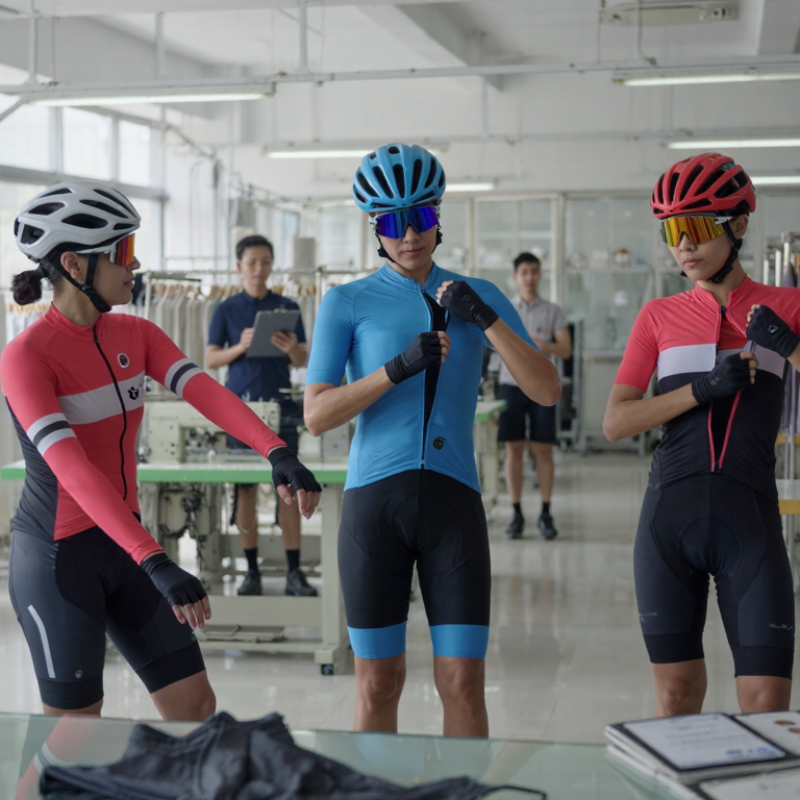
Choosing reliable Cycling Apparel suppliers is rarely as simple as comparing catalog prices. Global buyers must examine fabric performance, stitching quality, production capacity, communication, and delivery consistency. A polished product page proves very little.
This guide introduces ten suppliers serving international cycling markets. It considers practical factors such as moisture management, abrasion resistance, reflective details, pad construction, size grading, and customization options. Buyers should also review factory audits, material certificates, quality-control records, and clear production timelines. Small details matter. A weak zipper can ruin an otherwise excellent jersey.
The selection reflects common sourcing needs, including private-label development, teamwear, retail collections, and repeat bulk orders. Supplier experience is important, but it should not replace independent verification. Ask for samples. Test them after washing. Check colorfastness, seam strength, and fit across several body types.
No ranking can suit every business. A factory with advanced production lines may not offer low minimum orders. Another supplier may provide excellent communication but limited fabric choices. That trade-off deserves attention. Some information may change as factories update equipment, certifications, or capacity. Buyers should confirm current evidence before signing contracts.
The following suppliers are compared through a practical, evidence-aware lens. The goal is not to promote one perfect partner. None is perfect. Instead, this overview helps purchasing teams ask sharper questions, reduce avoidable risks, and identify suppliers that match their quality, compliance, budget, and delivery expectations.
Top 10 Cycling Apparel Suppliers for Global Buyers?
Grand View Research’s cycling apparel data gives buyers a useful market framework. Its market size and CAGR figures help explain demand, regional growth, and future purchasing pressure. However, buyers should check the report edition, currency, product scope, and forecast period before comparing suppliers. Numbers need context.
A practical top-ten review should combine market evidence with factory-level checks. Examine fabric testing, stitching consistency, moisture management, size grading, and reflective details. Request production samples before negotiating large orders. Review audit records, delivery history, minimum order quantities, and communication speed. A supplier may offer a low price but lack reliable quality control. That weakness becomes expensive after shipment.
Regional demand also affects product selection. Warm markets may favor lightweight jerseys, while colder regions require thermal layers and wind protection. Cycling teams, retailers, and online sellers need different packaging and customization plans. CAGR suggests momentum, not guaranteed sales. Forecasts can miss inflation, weather changes, or shifts in commuting habits. Fit matters. I would score the ten suppliers against the same checklist, then inspect the highest-scoring factories personally when possible. A remote evaluation is efficient, but it can hide fabric differences and small sewing defects. This is where market research and practical purchasing experience must work together.
A supplier-neutral procurement comparison framework for global buyers. The table uses market, compliance, testing, logistics, and sourcing dimensions rather than company or brand-level data.
| No. | Supplier Evaluation Dimension | Relevant Market or Procurement Data | What Global Buyers Should Verify | Reference or Standard |
|---|---|---|---|---|
| 1 | Market Growth Outlook | Grand View Research reports a positive long-term outlook for cycling apparel, with a forecast compound annual growth rate of approximately 6.4% for the published forecast period. | Assess whether the supplier can support recurring programs, seasonal replenishment, and capacity increases in line with market growth. | Grand View Research, Cycling Apparel Market report |
| 2 | Product Category Coverage | Core cycling apparel categories include jerseys, shorts, bib shorts, jackets, vests, base layers, gloves, socks, and protective or weather-resistant garments. | Confirm fabric, pattern, grading, trim, and construction capabilities for each product category required in the buyer’s range. | Product-scope classification used in cycling apparel sourcing |
| 3 | End-User Segmentation | Major demand segments are commonly classified as men, women, and children, with different anatomical fits, size curves, and safety requirements. | Request documented size charts, fit samples, grading rules, and separate measurement specifications for each end-user group. | Grand View Research market segmentation |
| 4 | Distribution and Fulfillment Capability | Online and offline channels are established distribution categories in the cycling apparel market. Online purchasing requires reliable product data and repeatable fulfillment. | Review electronic order processing, carton labeling, barcode accuracy, drop-ship capability, and support for regional warehouses or direct-to-consumer fulfillment. | Grand View Research distribution-channel segmentation |
| 5 | Material and Fiber Transparency | Common performance fibers include polyester, nylon, elastane, and merino wool. Fiber composition must be accurately declared on product documentation and labels. | Require fiber-content test reports, raw-material traceability, color-lot control, and confirmation that elastane percentages remain within specification. | ISO 1833; EU Regulation (EU) No 1007/2011 |
| 6 | Performance Testing | Relevant technical characteristics include abrasion resistance, dimensional stability, colorfastness, moisture management, water repellency, and thermal comfort. | Set measurable acceptance limits for abrasion, shrinkage, pilling, colorfastness to washing and perspiration, spray rating, and fabric moisture performance. | ISO 12947, ISO 6330, ISO 105 series, ISO 4920, ISO 11092 |
| 7 | Weather Protection | Rain and wind products may require water-repellent finishes, laminated fabrics, taped seams, wind-resistant constructions, or hydrostatic-pressure testing. | Verify stated water-resistance levels, seam-sealing quality, wash durability of finishes, breathability data, and test conditions used for claims. | ISO 811; ISO 4920; buyer-specific performance specifications |
| 8 | Chemical and Product Compliance | Global shipments may be subject to chemical restrictions, restricted-substance lists, labeling rules, and product-safety obligations in destination markets. | Request a current restricted-substance declaration, chemical test reports, supplier declarations, and evidence of process controls for dyes, coatings, prints, and trims. | EU REACH Regulation (EC) No 1907/2006; destination-market RSL requirements |
| 9 | Sustainability and Traceability | Common buyer requirements include recycled-material documentation, responsible chemical management, wastewater controls, and supply-chain traceability. | Check transaction certificates where applicable, chain-of-custody records, recycled-content evidence, audit scope, corrective-action records, and factory-level environmental data. | Global Recycled Standard; Global Organic Textile Standard; ISO 14001 |
| 10 | International Shipping and Commercial Terms | Cross-border apparel purchases require agreed Incoterms, export documentation, carton specifications, lead-time control, and transparent landed-cost assumptions. | Compare sampling lead time, production lead time, minimum order quantity, payment terms, inspection points, shipping mode, customs documents, and Incoterms 2020 responsibilities. | Incoterms® 2020; buyer’s purchase agreement and quality manual |

When comparing a top-ten shortlist of cycling apparel suppliers, global buyers need more than attractive catalog images. Verify fabric composition, stitching, and testing records. For racewear, ask whether jersey panels, padding, and reflective elements follow current UCI equipment rules. A reliable supplier should provide technical files, not vague assurances. Request samples in two sizes. Check sleeve tension, zipper movement, and seam comfort after washing. In my sourcing experience, a polished sample can hide weak batch control.
ISO standards can strengthen confidence, but buyers must confirm their scope and validity. ISO 9001 addresses quality management, while material safety may require separate test reports. Compare MOQ by style, color, and size. One “low MOQ” may apply only to mixed orders. Lead time should separate sampling, production, inspection, and shipping. A factory promising twelve days may exclude fabric booking. Price comparisons need identical specifications. Include fabric weight, pad grade, printing method, packaging, and delivered-cost terms. Cheap is not always efficient.
Tips: Put every requirement in a signed specification sheet. Ask for a pre-production sample. Use an independent inspection before final payment, where practical. Keep a 10 percent schedule buffer during peak seasons. Review defect rates, remake policies, and communication speed. I would not approve a supplier from one successful sample alone. That judgment can be wrong.
This non-company-specific benchmark compares typical sourcing ranges used by global buyers. UCI compliance should be verified against the intended competition category and garment design. ISO 9001 refers to a quality-management-system certification, not automatic product certification.
Reference ranges: minimum order quantities of approximately 50–500 units, bulk production lead times of about 30–90 days, and indicative custom cycling-apparel prices of approximately US$25–80 per unit. Actual terms vary by fabric, customization, testing, order volume, shipping, and certification scope.
Top 10 Cycling Apparel Suppliers for Global Buyers
A useful supplier shortlist should show more than product photos. It should explain regional strengths, production scale, and quality controls. The top ten suppliers for global buyers may come from East Asia, Southeast Asia, Europe, South Asia, and Latin America. Each region offers different advantages in labor skills, fabric access, lead times, and export experience.
Product categories often include cycling jerseys, bib shorts, jackets, vests, gloves, arm sleeves, socks, and rainwear. Some factories specialize in high-stretch performance clothing, while others focus on team uniforms or entry-level collections. Manufacturing capabilities matter more than a broad catalog. Check whether the supplier handles pattern development, digital sublimation, flatlock sewing, bonded seams, reflective details, and custom labels in-house. Ask for fabric composition and test reports.
Small details reveal experience. A reliable supplier can explain stitch density, chamois placement, colorfastness, and size grading without vague promises. Request a physical sample before approving bulk production. Review measurement tolerances, packaging, inspection procedures, and shipment records. One supplier may produce excellent jerseys but struggle with waterproof jackets. That weakness is easy to miss in a polished presentation. Minimum order quantities, seasonal capacity, and communication speed also deserve careful comparison. A low price can hide slower sampling or inconsistent finishing.
Comparing ten cycling apparel suppliers requires more than reading catalogues. Production capacity should be checked through factory visits, recent audit reports, and sample timelines. A workshop producing 50,000 jerseys monthly may still struggle with complex bib shorts or sudden seasonal orders. Ask about cutting machines, sewing lines, overtime controls, and backup fabric sources. Capacity claims are not always transparent.
Customization separates suitable suppliers from ordinary ones. Review minimum order quantities, graded sizing, fabric weight, zipper quality, reflective placement, and packaging options. Request a pre-production sample with real artwork, not only a digital mock-up.
Certifications also need careful verification. Check the certificate holder, covered facility, expiry date, and material scope. A certificate for fabric content does not automatically validate the finished garment or labor conditions. Small details matter.
Trade data can reveal shipment frequency, destination markets, product categories, and possible seasonal patterns. However, customs records may use broad HS codes and may not identify the actual factory. Treat them as supporting evidence, not final proof. In my sourcing work, suppliers with steady shipments often showed stronger planning, but this was not guaranteed. One overlooked issue was communication during revisions. A supplier may sew excellent samples yet respond slowly when measurements change. That weakness can delay a launch. Look for clear production calendars, inspection records, and corrective-action reports before signing an order.
Choosing among the top 10 cycling apparel suppliers requires more than comparing catalog photos and unit prices. A practical audit should inspect fabric rolls, seam strength, zipper function, reflective details, and size consistency. Ask for recent test reports, production samples, and corrective action records. One failed wash test can reveal shrinking, dye transfer, or damaged graphics. Small details matter.
Sustainability claims also need evidence. Review recycled-content certificates, factory energy records, wastewater controls, and packaging practices. Traceability should reach the fabric mill, not stop at the trading office. Compliance checks should cover worker safety, restricted substances, labeling, and documented working-hour controls. Supplier questionnaires help, but they are not proof. An unannounced or independent audit is more reliable.
Total cost often changes after sampling. Include development fees, minimum order quantities, inspection charges, freight, duties, payment terms, and possible rework. Compare landed cost, not just the quoted garment price. Evaluate communication speed during a real size-set correction. That experience can expose weak production control quickly. Still, audits have limits. A polished factory visit may miss seasonal subcontracting or rushed final inspections. Buyers should record risks, assign owners, and set review dates. Perfect certainty is unrealistic. Better records reduce expensive surprises.
Request fabric details, stitching samples, and recent testing records. Check sleeve tension, zipper movement, padding, and seam comfort after washing. Catalog images are not enough.
Ask for technical files covering jersey panels, padding, and reflective elements. Request written confirmation of current racewear requirements. Vague assurances are weak evidence.
It should use real artwork, correct fabric, and the planned construction. Request at least two sizes. Wash both samples before approval.
Confirm the certificate holder, covered facility, expiry date, and material scope. A quality-management certificate does not prove every garment is safe. Separate test reports may still be necessary.
Compare minimums by style, color, and size. A low minimum may apply only to mixed orders. Ask for the exact calculation in writing.
Separate sampling, fabric booking, production, inspection, and shipping. A twelve-day promise may exclude fabric preparation. Keep a ten percent buffer during busy seasons.
Use identical specifications for every quotation. Include fabric weight, padding grade, printing method, packaging, and delivered-cost terms. Cheap is not always efficient.
Shipment frequency and destination patterns can support your evaluation. Customs records may use broad product codes and hide the actual factory. Treat trade data as supporting evidence, not final proof.
Review graded sizing, zipper quality, reflective placement, packaging, and fabric options. Ask about cutting machines, sewing lines, and backup fabric sources. Strong samples do not guarantee strong batch control.
No. Check inspection records, defect rates, remake policies, and revision speed. A supplier may sew one excellent sample, then respond slowly. That judgment can still be wrong.
This guide offers global buyers a practical framework for evaluating the Cycling Apparel supply market, beginning with an overview of market scope, growth trends, and the relevance of industry size and CAGR data. It explains how to assess suppliers against key purchasing criteria, including UCI-related product requirements, ISO-based quality systems, minimum order quantities, lead times, pricing structures, and production flexibility.
The comparison of ten international suppliers focuses on geographic coverage, product categories, manufacturing capabilities, customization options, capacity, certifications, and available trade information. It also presents a structured due diligence process covering factory audits, material and workmanship inspections, sustainability practices, regulatory compliance, supply-chain transparency, and total landed cost. By combining commercial, technical, and operational considerations, the article helps buyers identify dependable partners, reduce sourcing risks, and build a more efficient and responsible Cycling Apparel procurement strategy.